More clients.
Not more hands.
We build and run recurring workflows for accounting firms, so your team can handle more client work.
- Local time
- --:--:--
Illustrative animation: a bank feed from client books in QuickBooks, Xero, Zoho, FreshBooks, Shopify and Square matches line by line. A customer wire arrives 45.00 short, a person approves the intermediary bank fee, and the difference returns to 0.00. A vendor bill entered twice is caught, and a person voids the copy before Friday's payment run. One customer payment is applied across three invoices, including one 45 days overdue, with nothing left unapplied and no one asked.
Recurring client work, handled end to end.
We build each workflow around your clients' systems and rules, then run it every cycle. Your team gets the finished work, and only the items that need a decision.
- Each billing cycleBilling prepared and submitted
- As payments arrivePayments matched to invoices
- Every payrollTimesheets checked against attendance
- As loads closeCharges entered as invoices and bills
762 estimated operator hours saved per month
Across billing and timesheet review for one client. Reported in the October 2026 case-study briefs; the redacted captures show the applications in production.
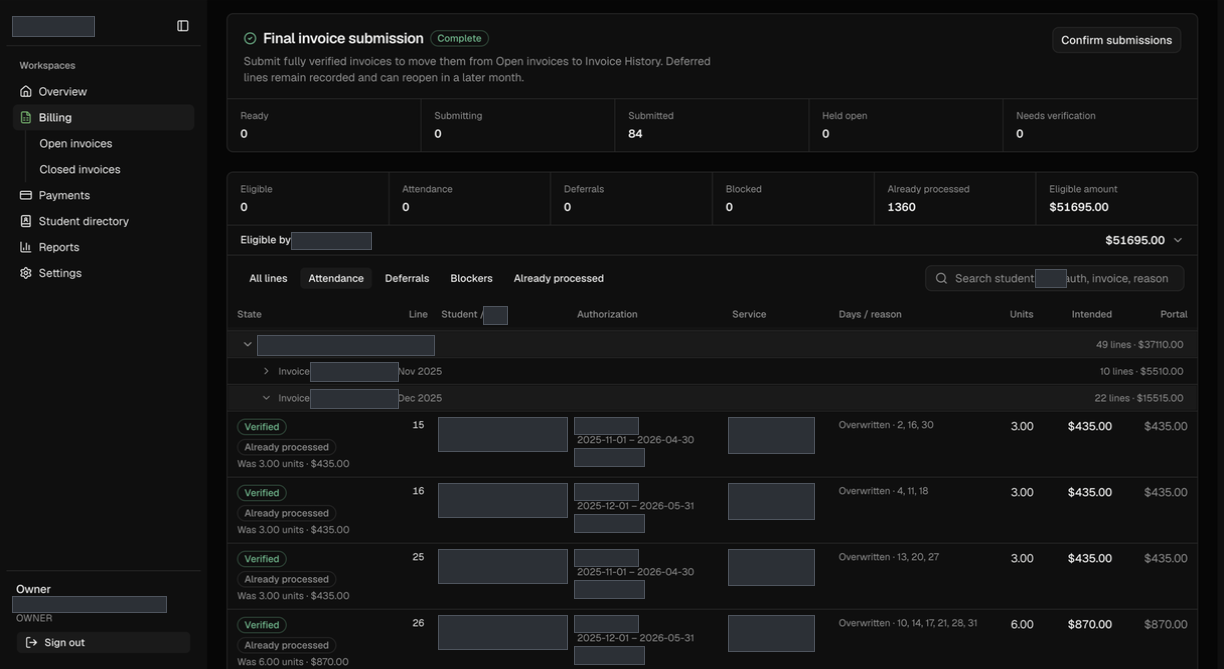 Production capture · redacted
Billing automation
- ~$3.12M
- billing and payment activity processed per month (USD)
- ~372 h
- estimated operator time saved per month
- $626k
- catch-up billed, May–Oct 7, 2026 (USD)
Reported as of Oct 8, 2026. Hours saved are estimates. Processing volume is not savings; catch-up billed is not collected cash or profit. The capture shows a different period.
Case study and measurement basis: Billing automation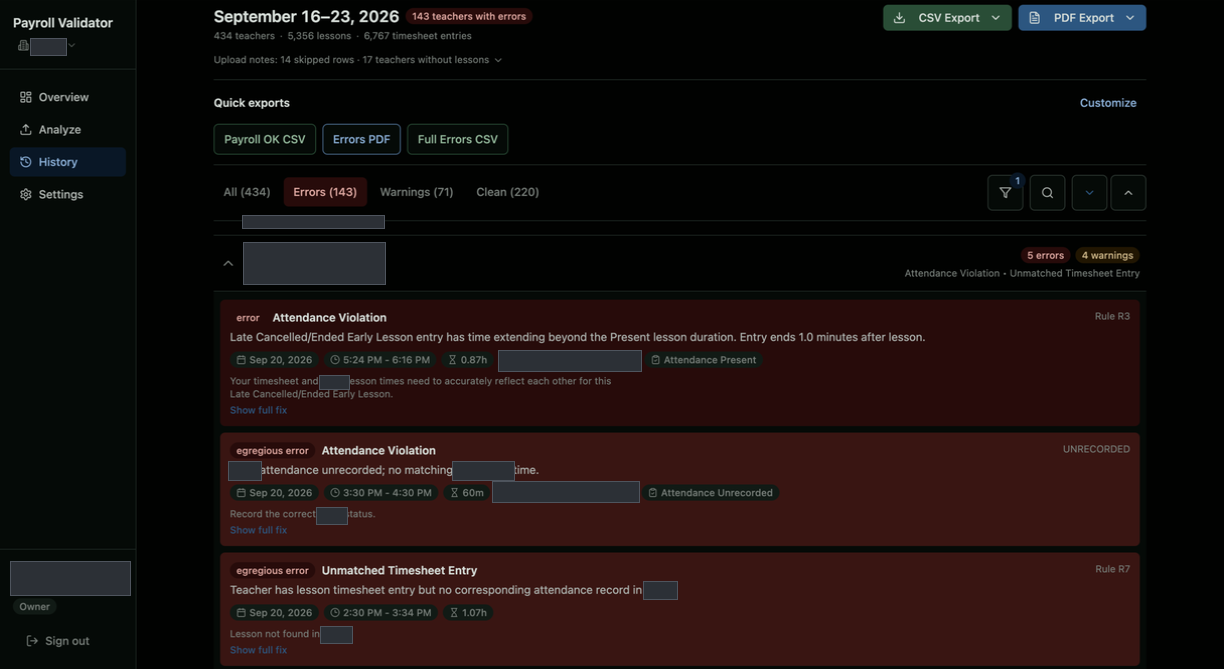 Production capture · redacted
Payroll validation
- 29,456
- timesheet lines reviewed per month
- ~390 h
- estimated operator time saved per month
- ~$813k
- payroll reviewed per month (USD)
Reported as of Oct 8, 2026, across two businesses and both monthly pay periods. Hours saved are estimates; payroll value is scale reviewed, not savings. The capture shows a different period.
Case study and measurement basis: Payroll validationOperational charges become QuickBooks invoices and bills.
When a load closes in your client's logistics system, its charges become the customer invoice and the carrier bill. Your team stops typing the same numbers twice.
Payments matched to the right invoices.
Incoming payer records are applied to the right invoices or service periods. A payment that could fit more than one waits for your team, with both options shown.
Timesheets checked against attendance.
Every timesheet line is compared with attendance and your agreed rules. Your team sees the supporting records and approves the time. Payroll stays a separate step.
We build it. We keep it running.
We map the workflow with your team, build it around your clients' systems, then run, monitor and maintain it as those systems change. One flat monthly fee covers the agreed workflow.
- Map
- Build and test
- Run and maintain
- Aevum Vector: Map one workflow and its outputs
- Aevum Vector: Build and test it on real records
- Your team: Approve the agreed outputs
- Aevum Vector: Run it every cycle
- Your team: Review held items
- Aevum Vector: Monitor each run
- Your team: Confirm submissions and approvals
- Aevum Vector: Update it when a system changes
One flat monthly fee for the agreed workflow
- Your clients keep their systems. We keep the tools that already work.
- Small firms qualify when the recurring volume justifies the work.
Start with one recurring workflow.
Bring one process your team repeats. We'll talk through:
- Workflow
- What your team repeats, and how often.
- Systems
- Where the records live today.
- Monthly volume
- How many items arrive each month.
- Fit
- Whether automation is worth it for your firm.